

‘Metamorphoses of Plastics’: São João da Madeira Footwear Museum’s research project traces the material’s links across diverse sectors, including footwear and accessories

Published
November 12, 2025
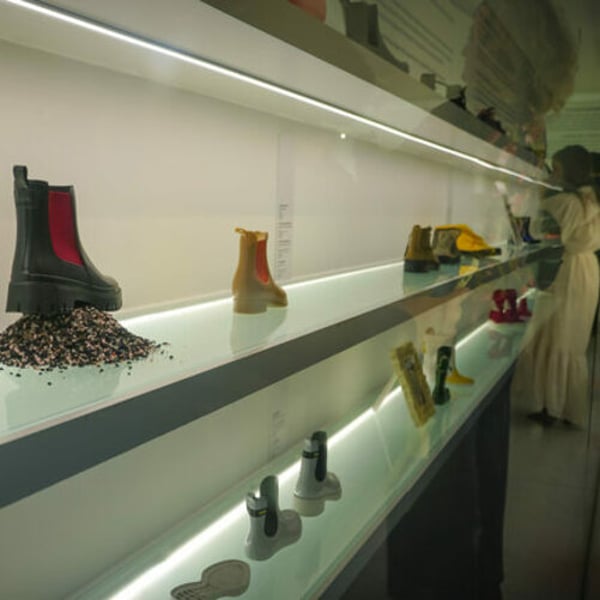
The exhibition entitled ‘Metamorphoses of Plastics: Reality and Multiple Approaches’ – a research-and-creation project carried out in partnership with the Shoe Museum and CIUHCT – Interuniversity Centre for the History of Science and Technology at the Faculty of Sciences of the University of Lisbon – brings together findings from 10 years of research by a group of Portuguese scientists and scholars, running until April 26, 2026. The exhibition runs in collaboration with European and American colleagues, “to better understand how plastics have become so important, how we can live better with them, and what this material means to all of us,” said the São João da Madeira Shoe Museum in a statement. The project also forges further links, particularly with the National Costume Museum (MNT) and a number of brands, to tell the story of plastic accessories and footwear in Portugal over the past decade.

“Plastics are everywhere, from inside our bodies to outer space,” the statement explains. “For 150 years, this class of materials has transformed the way we live and work, what we wear, and how we sustain ourselves and our planet,” it continues, stressing that the exhibition is the public presentation of this research and reveals “how the first plastics made luxury accessible to all, introduces some of the people and companies that made plastics an essential part of industrial development in Portugal, and highlights some of the most significant innovations in Portuguese plastic footwear,” it adds.
“‘Metamorphoses of Plastics’ invites all visitors to reflect on a material that has shaped – and continues to shape – our shared world. Come and discover how plastic has changed everything – and what we can still do with it,” it urges.
“Rather than limiting itself to the past, it also explores the paradoxes of plastic and addresses many of the concerns we all share about waste, re-use and sustainability, through an interactive, hands-on approach,” the statement explains, capturing the essence of what can be seen until next spring.

According to the director of the Shoe Museum, Sara Paiva: “This research project has been under way for 10 years; a few years ago it gave rise to an exhibition in Leiria, called ‘Plasticities’, and now ‘Metamorphoses of Plastics’ is, shall we say, a second phase of the project that brings together Portuguese, European, and American researchers and aims to present this academic research to the public, offering a multidisciplinary perspective on plastics,” she told FashionNetwork.com, noting the “researchers in the fields of chemistry, social sciences, heritage, the history of plastics, research, and conservation” that the exhibition brings together.
“This exhibition is not just a chronological reading of the history of plastics in Portugal,” she continues. “In the first part, in the first room, we have assembled objects that speak to the earliest plastics, including pieces loaned by the Museum of Natural History and Science, the National Museum of Music, and the National Costume Museum, which tell the story of the transition from natural materials to the first plastics.”
“Then, case studies are presented, along with study objects from some companies that were important for production and for the early introduction of plastics in Portugal, such as AG and Fábrica de Pentes do Ribeirinho, as well as specific cases in footwear, such as Xavi, Cortebel and, more recently, Lemon Jelly, which is one of the most paradigmatic.”

All these items of footwear are on display at the museum, alongside other fashion accessories from the MNT collection, such as fans, handbags, and hair combs, all 20th-century pieces made of plastic. “This is a major research project on plastics, which the Shoe Museum has joined. We tell the story of plastics and use selected examples of footwear to tell that story,” Sara Paiva told FashionNetwork.com.
“At heart, it is about raising awareness not only of the issues surrounding plastic, but also of what can be achieved with it as a utilitarian material. It is about showing how plastic came to make luxury objects accessible,” continues the museum director. “And how did a material that began as a substitute for tortoiseshell, horn and mother-of-pearl become so widely democratised by the mid-20th century that we came to interpret it in a completely different way?”
“It is also a reflection on these paradoxes, on how, for example, society currently views plastics. One of the subjects addressed in the second room is precisely this.”

“Plastics have been absolutely vital to food, to health, to democratisation, for example, and even to footwear. But the result of overproduction in recent years has led us to see plastic as something disposable and even harmful to health, when its very premise runs counter to such use,” she concludes.
Guided tours are now open for booking, and the launch of the exhibition catalogue is planned for next year, before ‘Metamorphoses of Plastics’ closes. An international congress on the subject was held two days prior to the opening.
This article is an automatic translation.
Copyright © 2025 FashionNetwork.com All rights reserved.